The humble leafy green vegetable

From giant spinach to indigenous spider plant, leaves cooked in oil and onions are referred to broadly as mboga. And most Kenyans eat these greens every single day.
Cooked greens are often the most nutritionally significant part of a family's diet. They are also a key source of income - and pride - for a large number of Family Care households.
In this update we celebrate the humble leafy vegetable and its surprisingly central role in the lives of those we serve.

It's mboga, and it's for dinner
Leafy greens pack nutrients and make the perfect complement to Kenya's staple food, calorie-dense ugali made from ground maize.
The two go together, side-by-side on the dinner plates of every family we support, most days of the year.
What counts as mboga? Just about anything and everything if its green, leafy, and cooks down on heat.
Giant-leafed spinach and collard greens are the most prolific types of mboga, growing quickly and plentifully. Slower-growing indigenous greens like cowpea leaves, spider plant, and sunhemp are lauded for flavor and nutrition. Often, two or more greens are cooked together.
Whatever one's choice of mboga, it's what goes with ugali to make a meal.

Almost everyone, almost everyday
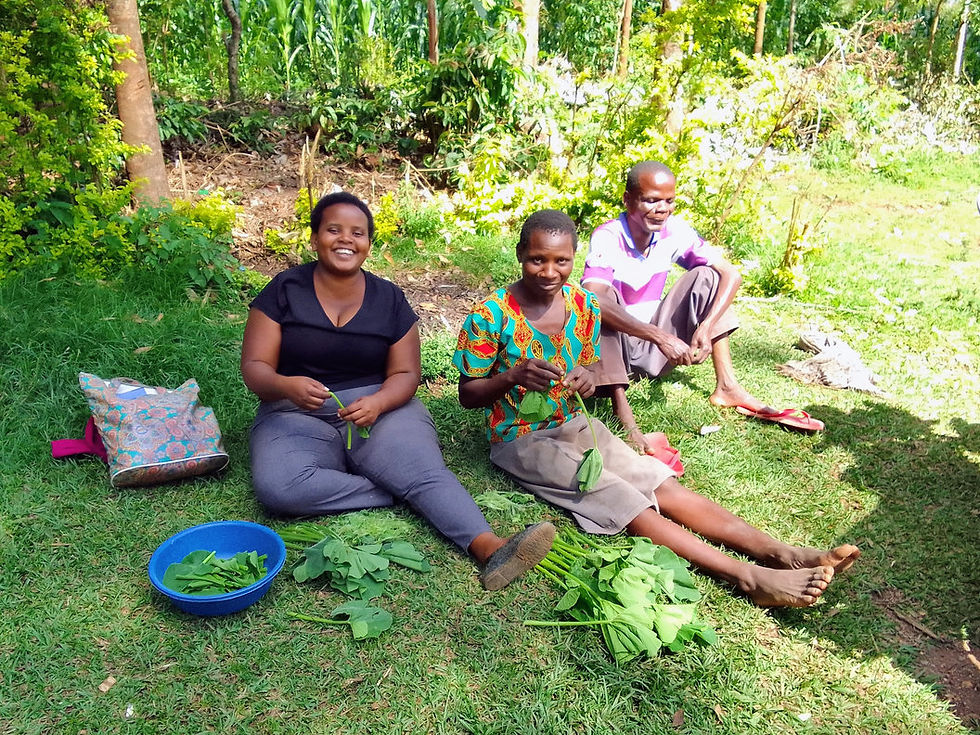
By reliably accompanying maize, leafy vegetables become a second staple food, providing flavor and nutrition to accompany a favorite starch.
The pattern isn't true for all peoples in all corners of Kenya. But in the western region where we work, ugali and greens are eaten by most people, most days.
While protein is largely missing from this basic meal, that is what economic circumstance dictates. This is true to the extent that the most common vegetable - collard greens - is called sukuma wiki. This means 'push the week', a linguistic nod to the historic ubiquity of greens amidst the unavailability of other food.
Common people add eggs, beans, or small dried fish to this staple meal as their budget allows. Red meat and (culturally revered) indigenous chicken are for special occasions or the middle class.
Those without money may skip protein for days or weeks on end, making the nutritional importance of daily cooked greens all the more significant.
The urban poor struggle to afford these vegetables. But in rural areas, a motivated farmer can grow mboga in plenty, assuring more than enough for children and perhaps enough for sale.
Mboga and Family Care

A generation or two ago, different mboga grew wild in vacant fields. And many types still do, that's how robust they are in the area's climate. But farms are now smaller and more crowded, making foraged greens a rarity.
These days, even the local varieties of greens must be cultivated. That's why our Family Care program spends a lot of effort helping farmers to grow more, eat more, and sell more.
Production training
While a full 91% of families already grow leafy greens to eat when they join our program, the variety and size of their harvests can always be greatly improved with education.
Family's Care's agriculture training covers everything from soil fertility and seed spacing to kitchen gardens and marketing vegetables for sale.

Seeds, supplies, and water
Family Care support includes seeds and seedings to expand the variety of veggies grown, with lessons on when to save seeds (indigenous crops) and when to use hybrid seed (usually exotics).
The program often provides things like farm tools and assistance building vertical gardens. Crucially, families also receive a water tank for harvesting rain. It won't provide enough to irrigate a farm, but it keeps seedlings going and can help a family grow greens to eat in the dry season.
Families newly joining our program grow a median of 4 different types of green leafy vegetables. But after only one year of support, that average nearly doubles to 7 different types of greens.
Kitchen gardens
One of our program's many goals is for every family to cultivate a 'kitchen garden.' This is a place to grow veggies for daily consumption, and we often see very impressive results.
Cone or sack gardens, raised beds, and other systems that conserve water and soil nutrients are especially popular among farmers trained through Family Care.
There is pride to be found in a beautiful plot out front, and many families put in tremendous effort to ensure their kitchen gardens are well designed, well-tended, and exploding with growth.

Continuous harvests
The beauty of most leafy greens is that they aren't harvested once. From spinach and collards to all the indigenous varieties of mboga, every single one is harvested continuously for months on end.
Farmers keep weeds down and pluck the biggest leaves for meals or for sale. After a plant recovers, the process is repeated. A keen farmer can rotate these partial harvests to pluck enough fresh mboga for dinner every day, and for sale at least once a week.
The plants don't last forever, but several months of continuous harvesting really adds up.
Thick and long sukuma stems reveal months of past harvesting. The large healthy leaves suggest a possibility of many more harvests to come.

Family income
Because leafy greens are ever-present in the diet of western Kenyans, there are customers aplenty for someone near town who grows excess. Farmers can supply green grocers in the market, or sit along the roadside to sell produce themselves.
Families in deeply interior areas might struggle to find buyers much of the year, because transport to towns is costly and most neighbors grow their own veggies. But during dry seasons, many neighbors lack, and savvy farmers easily sell.
Leafy greens are the single most common source of income among those served by Family Care. They don't always bring in as much money as other activities, but among families we serve, they're the most common entry point into farm business and perhaps any business. The only thing that comes close in universal popularity is raising chickens.
Of course, it's not easy money. With every non-farm household buying greens, there are many sellers and it's a highly competitive market. A giant bunch of greens can go for as little as 10 or 20 cents.
For many Family Care families, who cobble together income from several sides, growing greens for sale is one of the best opportunities around.

MAKE MBOGA AT HOME
A quick recipe for Kenyan-style cooked greens

INGREDIENTS
Use whatever type(s) of mboga you like. Big leaf spinach, collard greens, and kale are easy to find in the US, but don't limit yourself. Come summertime, cooked pumpkin leaves (seveve) will be delicious. Or spinach mixed with bitter dandelion greens.
What else? You also need some oil, onions, tomato, and salt.
Garlic and bouillon can be added to make it fancy and flavorful.
And consider some milk at the end for a traditional, creamy kick.
STEP 1 - CHOP
Slice your mboga greens very thin for tenderness.
This is easily achieved by bunching them first (as pictured below).

Mince your onions and dice tomato quite small, with quantity according to your taste and budget. Garlic is optional.
STEP 2 - COOK
Cook it up over medium-high heat. First, sizzle onions (and garlic) with salt, until darker and aromatic.
Then, throw on tomatoes for a minute or two, and perhaps a little bouillon.
After tomato is cooked in, add your thin-sliced greens and stir while cooking it all down. Five or ten minutes until it's ready. There's flexibility, but don't let it get dry.
Avoid using a lid with collards or kale, as that might become soupy.
Voila! Your mboga is now done.
You can optionally add some whole milk at the end, for creaminess, when your greens are otherwise ready. Cook it down again to thicken. The healthiest and heartiest types of greens really need dairy to offset acidity and bitterness. With softer leaves, milk is an optional luxury.

STEP 3 - SERVE
Serve with a big piece of ugali if you have it (polenta is similar). But don't worry, rice or potatoes can also be a solid starch pairing in this case.
A protein, from meat or fish to beans or eggs, might steal the show but that's ok.
Enjoy.